
The basics
What is an OVDP tracker and why use one?
OVDPs, or domestic government bonds, are government securities under which Ukraine undertakes to repay the holder’s face value and pay income according to the terms of a specific issue. An OVDP portfolio tracker is a tool that organizes information about these bonds and helps you:
Track OVDP issues on the market, their currencies, maturity dates, and coupon payments.
Maintain a history of purchases and other transactions.
Monitor coupons and maturities.
See OVDP performance in the context of your complete portfolio.
Strum is not a broker and does not execute trades. It is a service for record-keeping, data management, and capital analysis.
Accurate records
What OVDP data should you track?
For accurate OVDP portfolio records, you should record more than just the bond name and coupon.
| Data | Why it matters |
|---|---|
| ISIN | A unique issue code. It prevents confusion between bonds with similar maturity dates. |
| Currency | UAH, USD, or EUR. It is needed for an accurate portfolio structure. |
| Quantity | For example, 10 bonds. It is used to calculate the position size. |
| Purchase price | The actual transaction price. It may differ from face value. |
| Face value | The face value of a hryvnia-denominated OVDP is UAH 1,000 per bond. |
| Coupon | The payment amount or rate and schedule for a specific issue. |
| Purchase date | Helps reconstruct the portfolio history. |
| Maturity date | Shows when the face value is expected to be repaid. |
| Fees | Bank or broker costs affect the actual result. |
| Yield and result | Purchase price, coupons, fees, and P&L should be considered; compare issues using yield to maturity (YTM) when the intermediary provides it. |
Four steps
How to track OVDPs in Strum
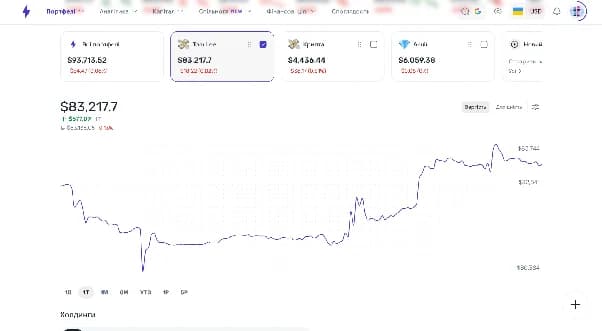
1. Create or select an investment portfolio
OVDPs can be included in a portfolio with other assets, or different investment strategies can be separated into individual portfolios. Strum supports multiple portfolios depending on your subscription plan.
2. Add an OVDP and its purchase transaction
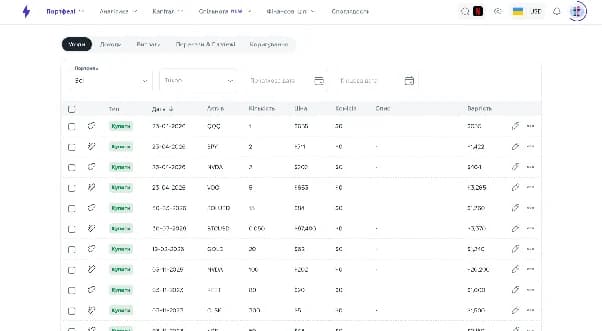
Strum lets you add assets manually and edit transactions. The transaction journal lets you manage transaction details.
Bond quantity.
Purchase price.
Transaction date.
Currency.
Fee, if applicable.
3. Monitor value and performance in one portfolio
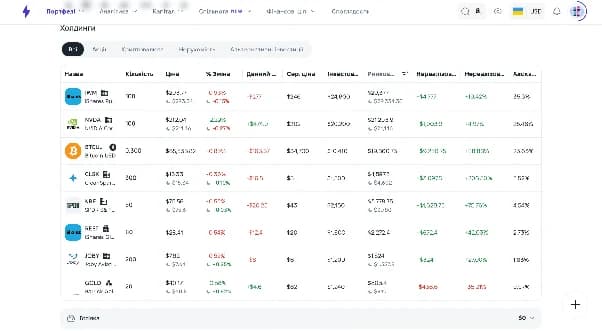
After adding positions, you can compare the invested amount with current value, review P&L, and see the OVDP share of total allocation. This makes it easier to assess the complete portfolio tracker rather than a single issue.
4. Track passive income, payment dates, and maturities
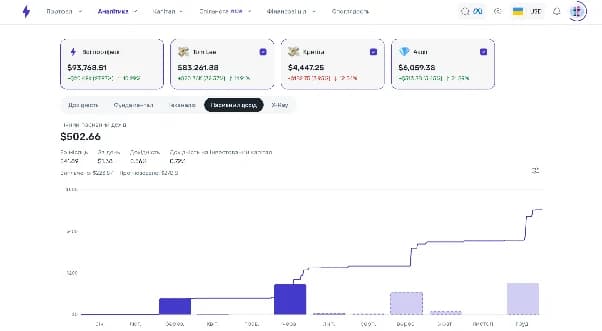
Strum displays passive income from dividends and coupons by month. This format simplifies coupon tracking, helps you work with the payment calendar, monitor receipts, and plan reinvestment.
Capabilities
Strum OVDP portfolio tracker features
| Feature | What it provides |
|---|---|
| OVDPs with other assets | One view of capital instead of a separate OVDP portfolio. |
| Transaction journal | A history of purchases, amounts, quantities, and fees. |
| Current value and P&L | Assess position results. |
| Passive income | Coupons are displayed with other income. |
| Multiple portfolios | Separate different strategies conveniently. |
| Allocation | See the share of OVDPs among other assets. |
| Financial goals | View investments in the context of a long-term plan. |
| Daily OVDP updates | Strum updates OVDP and bond data once per day. |
| Complete capital view | See stocks, ETFs, cash, bonds, and other assets in one system. |
Who it is for
Who can benefit from an OVDP tracker?
First-time bond investors
People who bought their first bonds and want to track transactions, coupons, and maturities without several spreadsheets.
Investors with several OVDP issues
As the number of issues grows, manually tracking ISINs, currencies, prices, coupon dates, and maturities becomes harder. An OVDP tracker organizes this data into a clear structure.
Investors with different asset classes
If a portfolio contains OVDPs, stocks, ETFs, cash, and other assets, Strum lets you assess government bonds as part of total capital.
Good practice
Common OVDP tracking mistakes
| Mistake | What it can cause |
|---|---|
| Confusing face value with purchase price | An inaccurate view of the capital actually invested. |
| Looking only at the coupon rate | The coupon rate alone does not show the actual return on an investment because the result also depends on purchase price, fees, and other transaction terms. |
| Ignoring fees | Portfolio performance appears better than it really is. |
| Not monitoring payments and maturities | Cash movements and reinvestment timing are easier to miss. |
| Keeping OVDPs separate | Their weight within total capital becomes harder to assess. |
Comparison
OVDP tracker or Excel: which is more convenient?
Excel remains useful for a simple portfolio. Strum reduces manual work as the number of assets, transactions, and accounts grows.
| Excel | Strum OVDP tracker |
|---|---|
| Flexible custom formulas and structure | A ready-made portfolio structure |
| Data often needs manual updates | OVDP data is updated once per day |
| P&L and allocation require configuration | Metrics are integrated into portfolio analytics |
| Convenient for simple records | Scales better across assets and portfolios |
How Strum features work together
To assess bonds alongside the rest of your capital, a unified investment tracker brings OVDP together with stocks, ETFs, crypto, cash, and other assets.
After adding OVDP, the portfolio allocation map shows their share among your other assets and helps you spot concentration.